Wellness Library
A collection of thought pieces, industry insights and research, curated by our experienced clinicians.
Blog Post
Apr 1, 2026
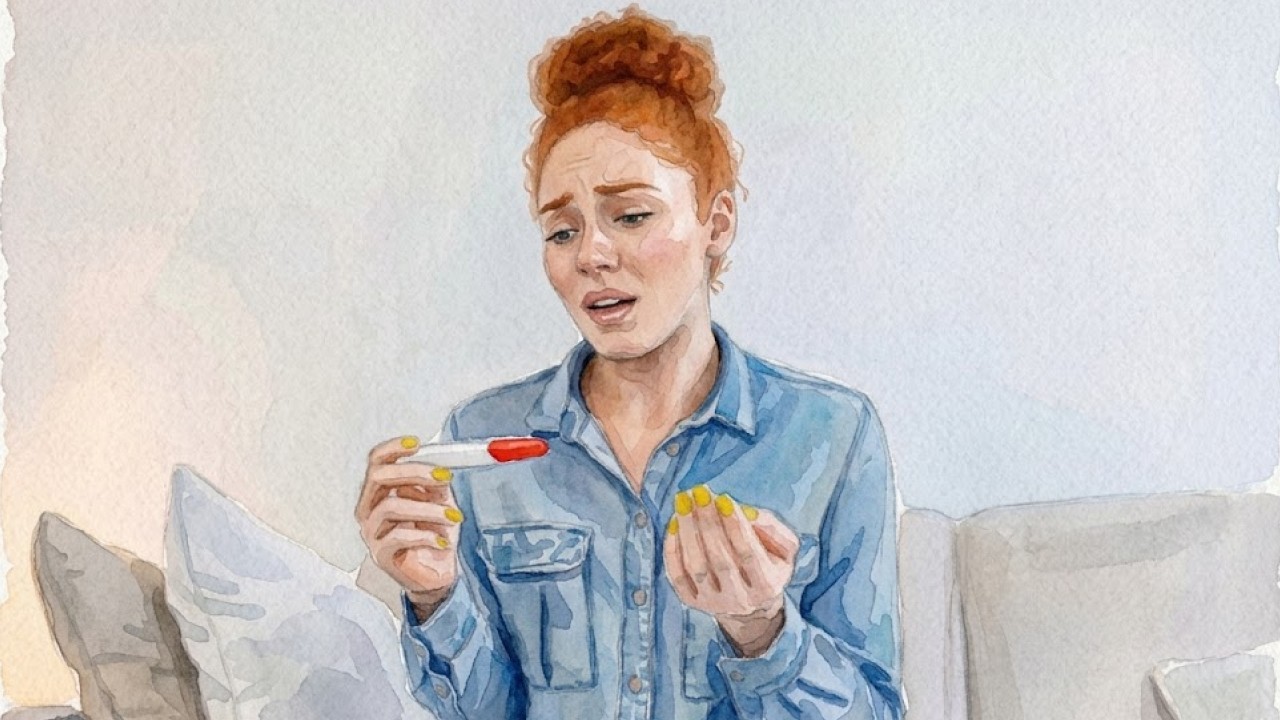
Infertility and miscarriage are grief experiences that many women endure quietly.
When I went through it, I didn’t even recognize it as grief.
Today, as a therapist, I understand exactly what it was.
But at the time, I only knew that my heart was breaking.
My husband and I had a plan for our life together. It was simple and beautiful. Marriage, military life, two kids, and two cats.
At the time, my husband was a busy U.S. Air Force Captain and I was substitute teaching. I also served as a Key Spouse, supporting military families whose spouses were deployed. I filled my days organizing care packages and answering calls from families in distress as they navigated the stress of military life.
Helping others gave my days purpose.
But in the quiet moments, I was grieving.
After losing three pregnancies, I began to wonder if children would ever be possible for us. I cried out to God often.
“Why, Lord? Why can’t I do what a woman is supposed to do?”
Looking back now as a therapist, I can clearly see that I was experiencing profound grief.
But at the time, I didn’t have the language for it.
Baby showers were brutal. Sometimes I simply could not go. I would send a gift instead. For a time, I even distanced myself from friends who had babies because every pregnancy announcement on social media felt like a painful reminder of what we had lost.
People tried to comfort me by saying, “It will happen in God’s timing.”
But when you are struggling with infertility, time can feel like your enemy.
I felt like I was getting older by the minute.
Because we were living on an Air Force base, we were able to have fertility testing done at no cost. We hoped the testing would provide answers.
Instead, it brought more uncertainty.
The doctors explained that fertility drugs were not recommended for me because of the possible risks of blood clots, stroke, or even heart attack. And even if I chose to take those risks, there was no guarantee that I would become pregnant or carry a baby to term.
Hearing that was devastating.
When you long for a child, you want solutions. You want hope.
Instead, it felt like another door quietly closing.
So I prayed.
Often.
I thought about the story of Sarah and Abraham in the Bible, and I prayed that if it was God’s will for us to have children, He would make a way.
And then we waited.
About six months later, I had some free time and began researching adoption. Domestic adoption frightened me. I had read stories about families becoming attached to an infant only to have the child returned to the biological parents.
So we began exploring international adoption.
The more I read about orphanages overseas, the more my heart broke. Some reports described babies lying in cribs all day with no one responding to their cries. I knew we had to do something.
Our first application was to adopt from China.
But we were denied.
Not because of anything major.
Because my BMI was one point above their requirement.
If you have ever struggled with chronic health issues, you know that losing weight is not always as simple as exercising more.
It was another crushing disappointment.
Then our adoption agency told us about Russia.
We had always imagined having a child who looked Chinese because my husband is half Chinese. In fact, I used to joke that I always wanted a Chinese child with freckles.
But we followed the path that opened.
The first step was the home study, which I often call a “paper pregnancy.” The process required mountains of paperwork—medical exams, psychological evaluations, financial records, background checks, and documents that had to be apostilled.
At the time, that meant a four-hour drive in person every time.
Eventually I even stopped working because the process was so time consuming.
In April 2010 we submitted Dossier #1, hoping to be matched with a child under the age of two since attachment theorists emphasize that the first two years of life are crucial for secure attachment development.
Then we waited.
Just as things were moving forward, the adoption world was shaken by international news. A woman from Tennessee named Tori Hansen had returned a child she adopted from Russia—alone, on a plane—with a backpack and a note.
The ripple effects were enormous.
Russia threatened to close adoptions to U.S. citizens.
Once again, we waited.
And prayed.
Then in September 2010, we received the call.
The adoption coordinator said they had a match.
But we had to decide that very day if we wanted to proceed.
They sent us her photo.
I remember staring at it and crying. She looked so small and pitiful, almost as if she had not known much love. But there was a sparkle in her eyes.
And in that moment, I felt a quiet whisper in my heart.
“Here is your little girl.”
Soon we were securing visas and passports for the long journey. We traveled first to Moscow for additional Russian medical exams—even though we had already completed them in the United States. I still remember that the doctor who examined me smelled strongly of vodka.
Then we boarded a ten-hour flight to Vladivostok.
When the orphanage director opened the door and our daughter toddled into the playroom, I cannot fully describe that moment. We were allowed to feed her, hold her, and begin the first fragile steps of bonding.
But after only a week, we had to return home to complete Dossier #2.
Leaving her behind was heartbreaking.
We submitted the final paperwork and waited again, hoping she would be home by Christmas.
But Russia celebrates Christmas in January, so everything paused.
Finally, on a cold February day, we received the call.
We had a court date on February 7th.
We packed again and flew back to Vladivostok.
During the court hearing, the judge asked us many questions.
Then she said one word.
“Da.”
Yes.
We were finally a family.
Because of passport and citizenship requirements, we had to remain in Vladivostok for ten more days before leaving the country. My husband had to return home for military duty, so there I was in a foreign country, knowing only a few Russian phrases, suddenly a brand new mom.
Those early days were overwhelming and beautiful all at once.
Then came a moment I will never forget.
On Valentine’s Day, February 14, 2011, our daughter was officially placed into my arms.
What a phenomenal day that was.
After years of heartbreak, waiting, praying, and paperwork, I was finally holding my child.
Eventually we flew back to Moscow to complete the final steps at the American Embassy so that when we entered the United States, she would automatically become a U.S. citizen.
While waiting, she and I explored the city together. We danced in our hotel room. We visited Red Square and the famous St. Basil’s Cathedral.
Then it was time to come home.
She didn’t sleep a single wink on the flight.
When we landed in Washington, D.C., my mom and my husband were waiting with balloons and a Welcome Home sign.
Our daughter was finally home.
The early months had challenges. She struggled sleeping alone because she had always slept near other children in the orphanage. She was diagnosed with Fetal Alcohol Effects, not full Fetal Alcohol Syndrome, and she desperately needed to gain weight because she was considered failure to thrive.
But within a year she had doubled her weight and spoke perfect English.
Today she is a beautiful young woman—almost eighteen years old.
Did the grief of losing our first babies disappear?
No.
That grief still lives quietly in my heart.
But I also believe that God had a greater plan.
Across the world, in a city called Vladivostok, there was a little girl waiting for us.
And she was always meant to be ours.
If you are struggling to conceive, navigating infertility, considering adoption, or carrying the quiet grief of miscarriage, please know this:
Your grief is real.
Your longing is valid.
And you do not have to walk through it alone.
As someone who has lived this journey personally—and now supports others professionally as a therapist—it would be an honor to walk alongside you.
Blog Post
Mar 17, 2026
We often think of therapists as people who have always had it "all together," like blank slates who move through life with Zen-like calm. But if you walked into my office today, you might be surprised to know the "secrets" I carried for decades.
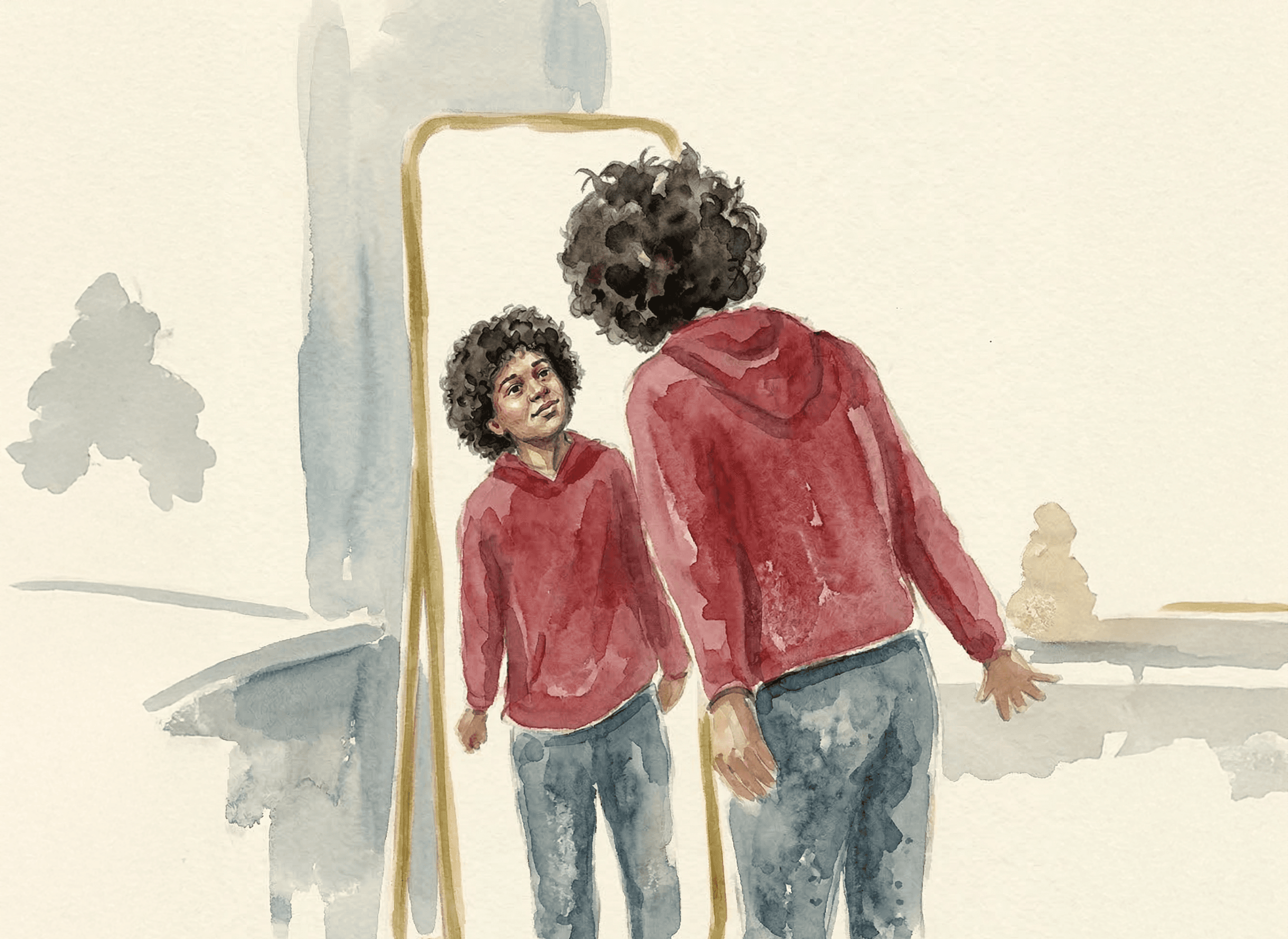
I wasn't always the confident professional you see now. I was a shy kid; I was the girl who felt invisible and ugly. For a long time, I carried a weight heavy enough to break me—and I let it break me for years because I knew nothing better.
The Search for Being Seen
Growing up, my home was defined by a specific kind of self-imposed pressure. My mother was just sixteen when I was born, and eleven months later, my brother arrived with severe cerebral palsy. Because he required so much care and attention, I stepped into a role many trauma survivors recognize: “The Perfect Child.” I thought if I was perfect, I wouldn't be a burden. I set out to make straight A’s, and when I made a B or a C one year in high school Algebra II/Trigonometry, it felt as if the world had ended. Being an "A-student" was all that defined my worth back then.
My mother worked hard in those years, returning to school to become a nurse. While I longed for a relationship with her like the one my little sister has now, I recognized that she loved me even while she was busy building our future. My grandparents stepped in to provide parental support, and we lived a simple, happy life: riding four-wheelers and swimming in an above-ground pool in rural Alabama.
Perhaps my mom and I had to grow up together, in a sense. She eventually found Jesus later in life and devoted herself to caring for my grandparents as their health declined. During that same period, my uncle succumbed to a drug overdose. My grandparents, the constants I looked up to as a little girl, passed away in 2021 and 2024. Their bodies simply wore out after battles with dementia, strokes, and heart attacks. They were the ones who led me to college, and it was through a scholarship from my grandfather’s company that I obtained my undergraduate degree.
As a young adolescent, I leaned into "cognitive distortions"—glitches in thinking like all-or-nothing logic, catastrophizing, and perfectionism, until they felt ingrained in my DNA.
The Aftermath: Hatred, Grief, and the "Rough" Years
Perfectionism is a lonely road. It led me to maladaptive coping mechanisms, like believing sex and love were the same. At 15, desperate to be "seen" and to belong to the “in crowd,” I was coaxed into a sexual relationship by a man over 20 years older than me. He used my need for validation to soothe his own marital issues. He took something I could never get back: my innocence.
While my family eventually took action against his criminal offenses, the internal damage was done. I spent my teens as a person I barely recognized: promiscuous, angry, and drowning in anxiety. In my early 20s, I faced health issues resulting from sexual abuse I had suffered even earlier, at age five.
Tired of being used and discarded, I joined eHarmony and met my husband at age 23. By then, I was working as a journalist and radio personality. A year before meeting him, I truly found Jesus after nearly dying from a serious infection. That changed me internally, but I still struggled to find where I belonged during the early years of marriage and motherhood.
My grandparents’ health declined further until they both entered hospice: a gift that allowed me to be there for their final days and last breaths. Watching someone you love take their last breath is bittersweet. Having worked in hospice, I knew they were headed to Heaven, but that didn't erase the grief that still hits me on birthdays and anniversaries. This March 15, 2026 marks two years since my grandmother passed. There are days I still miss calling her to hear her scripture of the day and her words of wisdom.
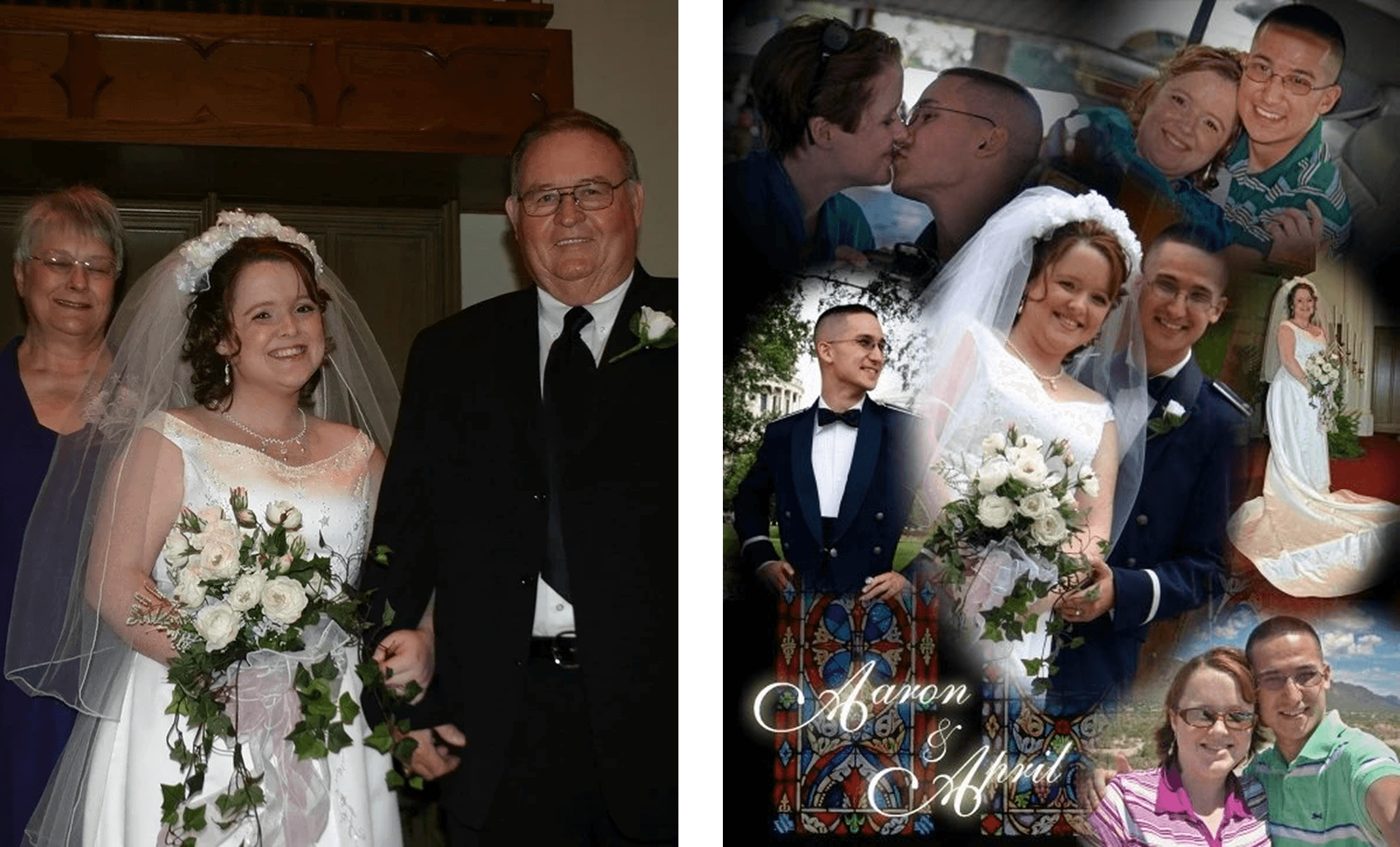
(Pictured Below: Left to Right: April at her wedding with her grandparents; April and her husband, Aaron)
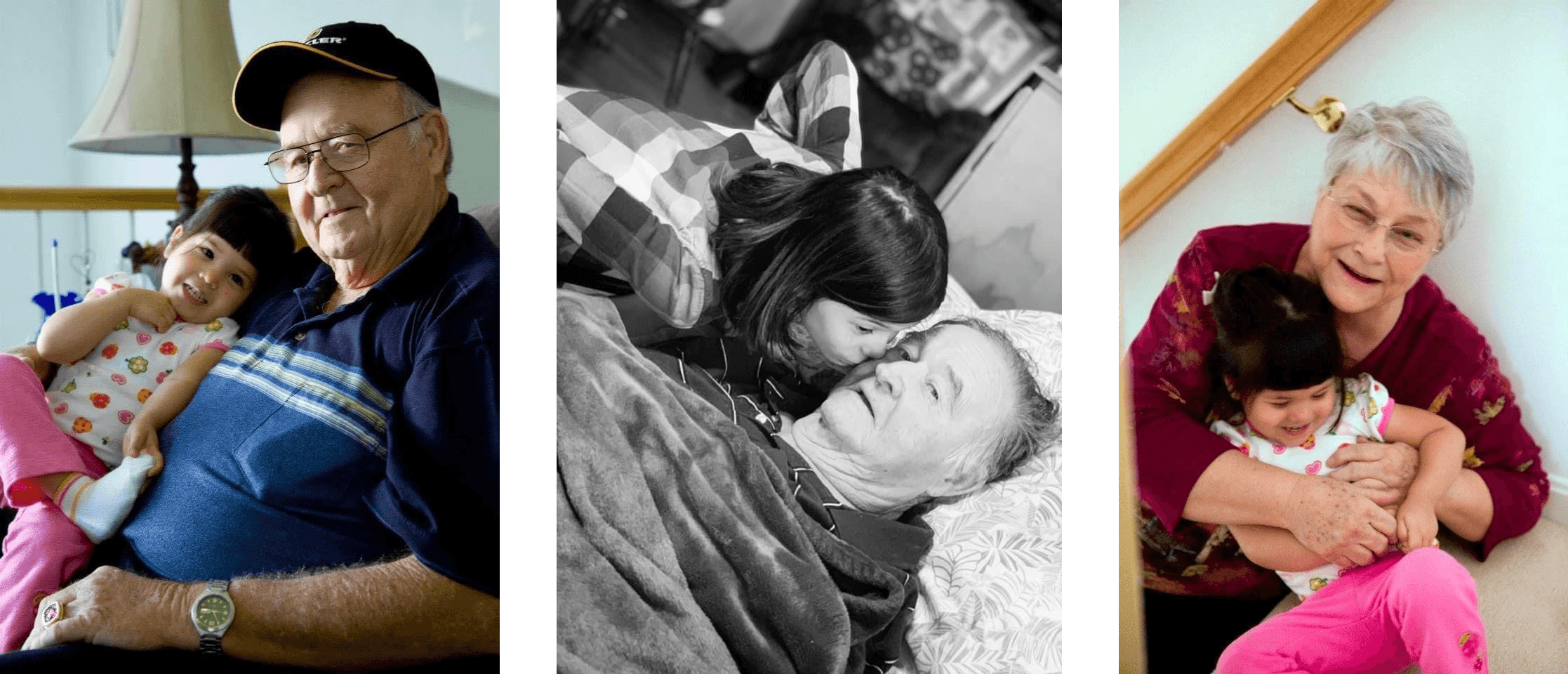
(Pictured below: Left to Right: April with her mom, April with her grandma, April with her grandpa)
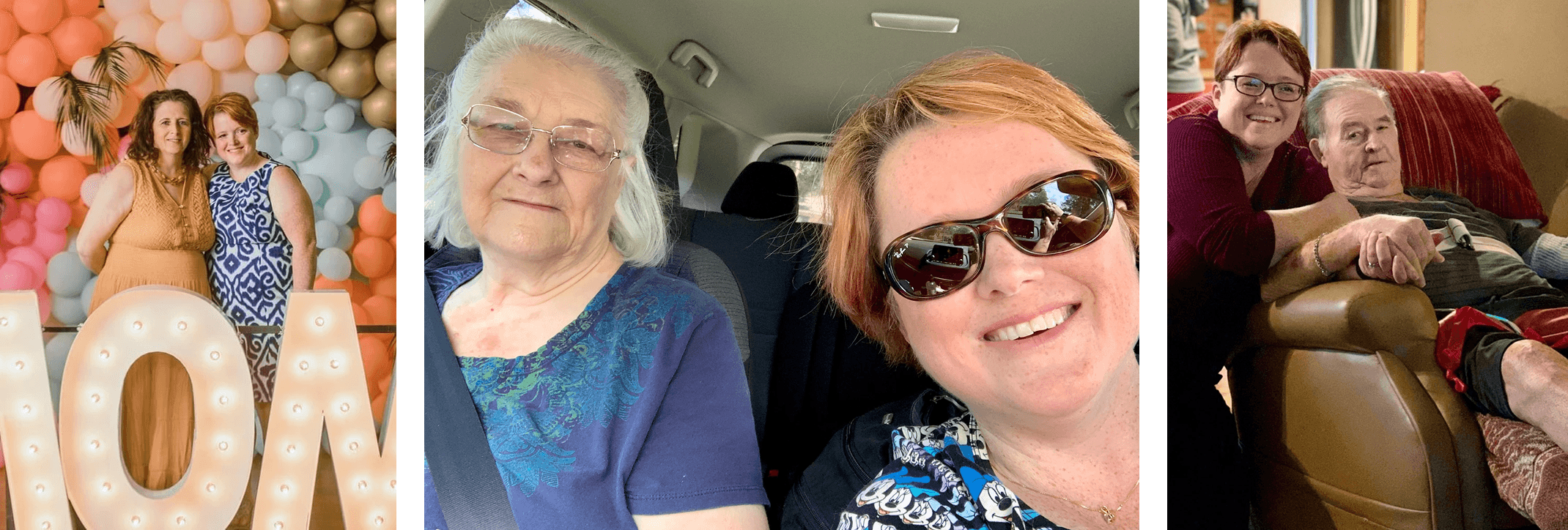
I was blessed that for 10 years of our daughter’s life, my grandparents were able to be a part of her life as great grandparents. She was able to experience the love of her “grammy” and “pappy,” differently than my own, but she was able to see how special they were.
(Pictured Below: Left to Right: April’s daughter with her great grandfather (2 photos), April’s daughter with her great grandmother)
Redemption and Resilience
The pain of losing them was a breaking point, and my husband was my saving grace. We married less than a year after meeting; he was everything I ever wanted in a family. Our union has faced strife: infertility, poor financial choices, my low self-esteem, and the fear of his military deployments–seven of them and an eighth likely coming at any time, but God has always taken care of our little family.
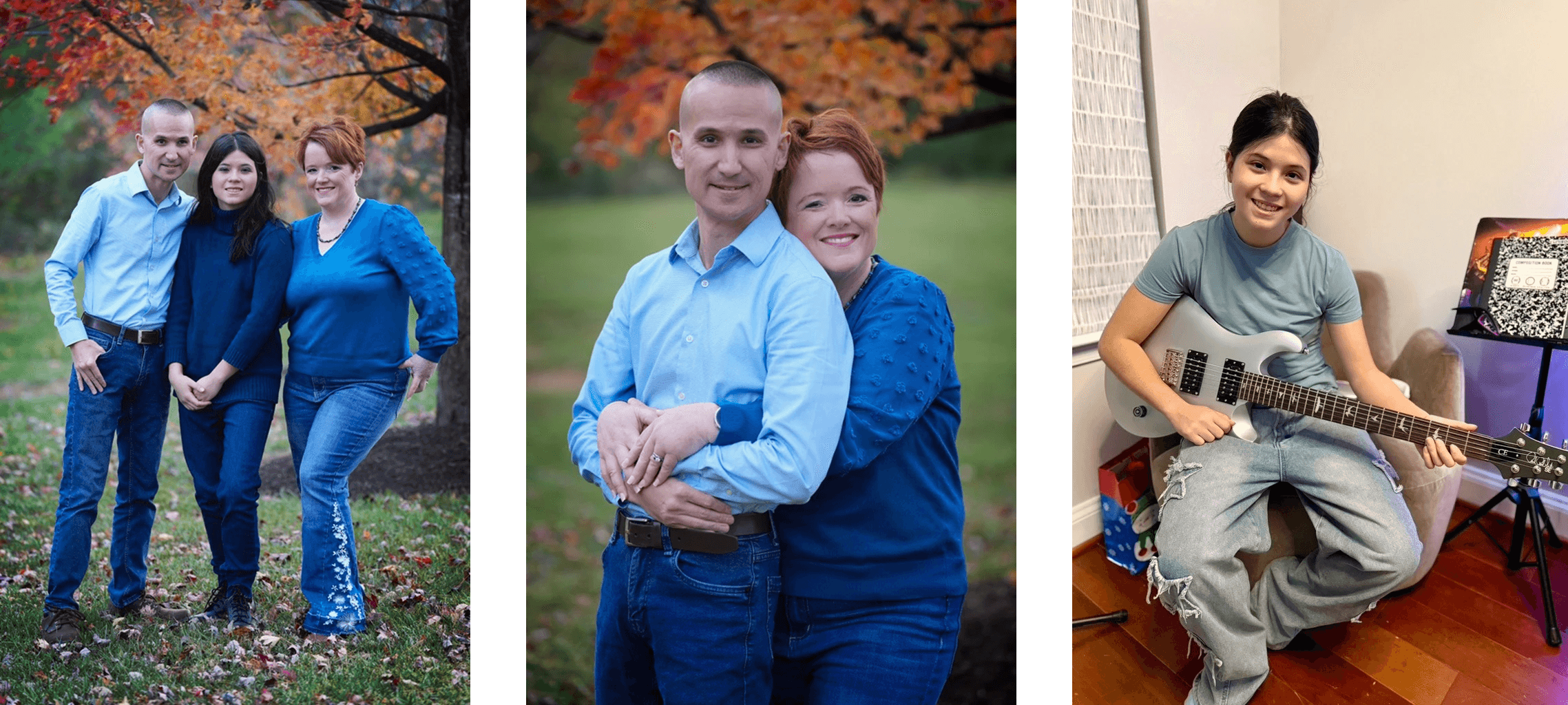
Today, we have been married for almost 20 years and have a beautiful 17-year-old daughter adopted from Russia. Our journey wasn't easy. I was often short-tempered and didn't know how to give nor receive healthy love. It has taken almost 40 years to learn how to reciprocate the love my husband gives—a love I never thought I was worth. Though I struggled to connect during my daughter’s early years, today she is a well-adjusted, empathetic, and loving young woman.
Pictured below, Left to Right: (April’s family, husband and daughter, Katie)
God continues to bless my marriage. I have the love of a husband who stayed when others might have given up. When we stood before our late pastor and made our vows, he meant every word, and now I do too.
Why I Specialize in Trauma and Grief
I didn't recover because time passed; I recovered because I did the work. I spent years in therapy and church unlearning shame and guilt. I had to learn how to break the ties that bound me to maladaptive behaviors.
I believe God had a plan for me the entire time, as promised in Jeremiah 29:11: “For I know the plans I have for you... plans to prosper you and not to harm you, plans to give you hope and a future.” The road was filled with potholes, but those bumps made me who I am.
As a therapist today, I work with children, teens, adults, and couples navigating the same "no-bounds" trauma I once did. When I look at my clients, I don’t see "troubled people." I see:
The survival spirit behind a "rough" exterior.
The exhaustion behind perfectionism.
The resilience that no one else has noticed yet.
Their beautiful and resilient exterior, perhaps that no one in their life has ever seen.
Healing is a Two-Way Street
Helping others continues to heal me. Every time I help a client process a repressed memory or find their footing in grief, I am honoring that shy 15-year-old girl. I am living proof that trauma is a chapter in your book, not the whole story.
If you are carrying a secret, or if you feel you must be perfect just to survive, I see you. I hear you. And there is a way back to yourself.
Note from the Author: Recovery isn't about erasing the past; it's about integrated healing. If you're ready to start your journey, you don't have to do it alone.

Blog Post
Mar 5, 2026
We all know what grief is supposed to look like. When we lose a close family member or a spouse, society immediately understands. People send cards, bring casseroles, offer time off work, and hold space for our sadness. There is a script, a timeline, and a collective acknowledgment that your world has just stopped turning.
But what happens when your world stops turning, and no one else seems to notice?
If you have ever experienced a profound loss that felt invisible to the outside world, or felt like you had to hide your sadness because it didn't fit the "rules" of mourning, you are not alone. There is a clinical name for this experience: disenfranchised grief.
What is Disenfranchised Grief?
Coined by grief researcher Kenneth Doka, disenfranchised grief refers to a loss that is not openly acknowledged, socially validated, or publicly mourned.
When society does not recognize your right to grieve, it strips away the traditional support systems we usually rely on. You might be left feeling isolated, confused, or even guilty, quietly asking yourself, "Do I have the right to be this sad?"
The short answer is: Yes. Your grief is valid.
Common Examples of Hidden Loss
Disenfranchised grief can take many forms. Because these losses lack standard social rituals (like funerals or formal mourning periods), they are often brushed under the rug. Some common examples include:
The loss of a pet: Often dismissed with "it was just an animal," despite pets being central figures in our daily lives and emotional well-being.
Miscarriage or infertility: Deeply personal losses that are often kept secret due to societal stigma or discomfort.
The end of a relationship: Breakups, divorces, or the fading of a close friendship can carry the same emotional weight as a death, yet are rarely treated with the same gravity.
Non-death losses: This includes losing a career, a home, a physical ability, or a long-held dream.
Stigmatized deaths: Losing a loved one to suicide, overdose, or an illness carrying social stigma can make survivors hesitant to seek support.
Estranged relationships: Mourning an abusive parent, an ex-spouse, or someone you had cut ties with can lead to incredibly complex, confusing emotions.
Why It Hurts Differently
Grief is already exhausting, but disenfranchised grief adds a layer of isolation. When your pain goes unacknowledged, it is easy to internalize society’s message and begin invalidating your own feelings.
Without closure, rituals, or a community to lean on, the grieving process is often prolonged. You might try to force yourself to "move on" before you are ready, simply because the world expects you to show up to work and life as usual.
How to Navigate Unacknowledged Grief
Healing begins the moment you give yourself permission to feel your loss. If you are navigating disenfranchised grief, here are a few gentle steps to help you process it:
Name it: Simply giving your experience a name can be incredibly freeing. Acknowledge that you are grieving, and recognize that your loss is real.
Create your own rituals: You do not need society's permission to memorialize your loss. Plant a tree, write a letter to the person (or pet, or life stage) you lost, or take a day off to simply be sad.
Find your people: Look for support groups—either locally or online—specifically dedicated to your type of loss. Connecting with others who say, "I understand," is a powerful antidote to isolation.
Seek professional support: A therapist can provide the safe, non-judgmental space that society might not be offering you. They can help you unpack complex emotions and find a path forward without rushing your healing.
Your Grief Deserves Space
You do not need to justify your heartbreak to anyone. Pain is not a competition, and there is no threshold you have to cross to earn the right to mourn. Whatever it is you have lost, your grief is a testament to what that person, animal, or dream meant to you. Be gentle with yourself, and remember that you do not have to carry it entirely alone.

Blog Post
Feb 24, 2026
I remember it like it was yesterday—except it was more than twenty years ago. The details are still vivid. The fever so high my teeth chattered. The uncontrollable shivering. The fear.
Earlier that week, I had experienced three obstructive kidney stones and underwent what should have been a routine surgical stent placement. But a week later, something wasn’t right. After hours in an emergency room near my hometown in Alabama, doctors discovered I had developed a psoas muscle abscess. What should have been simple had become life-threatening.
I spent weeks in the hospital receiving IV antibiotics, strong pain medication, and fluids. My life was saved—but my nervous system never forgot.
Twenty-three years later, I still notice a spike of fear when anything related to kidney infections or UTIs arises. For years, I struggled with severe health anxiety. Panic attacks sent me back to the ER more than once, convinced I was reliving that near-death experience. Since then, I’ve also endured a pulmonary embolism and a DVT in my left thigh—experiences that reinforced the message my brain had already learned: Your body is not safe.
If you’ve ever had a medical trauma, you may understand this deeply.
When the Body Remembers Trauma
Medical trauma is real. Even when we “recover,” our nervous system may continue to scan for danger. A minor symptom can trigger catastrophic thoughts:
What if it’s happening again?
What if they missed something?
What if this time I don’t survive?
What if what I saw on (insert your chosen social media or TV show) happens to me?
In my clinical work, I often hear similar stories from clients. A minor health concern spirals into worst-case scenarios. A routine doctor’s visit becomes overwhelming. The body tightens. The heart races. The mind jumps straight to catastrophe.
This isn’t weakness. It’s conditioning.
When your brain has lived through a true medical emergency, it becomes hyper-alert. It tries to protect you the only way it knows how—by assuming the worst so you’ll be prepared.
But protection can become imprisonment if left unchecked.
What We Do in Therapy
In therapy, we don’t shame anxiety—we understand it.
We explore:
What happened medically.
How the body stored that experience.
What thoughts automatically fire when symptoms appear.
What sensations trigger panic.
Then we gently challenge the catastrophic narrative.
Instead of:
“I will certainly die or get really sick anytime there’s a health issue.”
We work toward:
“My anxiety is loud right now, but this symptom does not automatically mean danger.”
We normalize anxious thoughts without letting them run the show.
Coping Skills That Help
Healing from health anxiety involves both the mind and the body. Some of the tools we often incorporate include:
1. Regulated Breathing
Slow, diaphragmatic breathing helps calm the vagus nerve and signal safety to the body. A simple practice:
Inhale for 4.
Hold for 7.
Exhale for 8.
Repeat for several minutes.
2. Cognitive Reframing
Ask:
What evidence supports this fear?
What evidence suggests a less catastrophic explanation?
If this were happening to a friend, what would I tell them?
3. Mindfulness & Somatic Awareness
Instead of fighting sensations, we practice noticing them:
“My chest feels tight.”
“My stomach feels unsettled.”
Without adding the story: “This means I’m dying.”
Yoga, progressive muscle relaxation, and grounding exercises can help reconnect you to your body in a safe way.
4. Exposure with Support
Avoidance strengthens anxiety. Gradual exposure—like scheduling routine checkups or sitting with mild symptoms without rushing to “Doctor Google or AI”—can retrain the brain that discomfort does not equal catastrophe.
5. Limiting Reassurance-Seeking
Repeated ER visits, excessive symptom-checking, or constant Googling can temporarily soothe anxiety but reinforce the cycle long-term. In therapy, we work on tolerating uncertainty in small, manageable ways.
6. Self-Compassion
Medical trauma changes people. Offering yourself grace matters. It’s okay if health concerns hit you differently. Healing isn’t about eliminating anxiety entirely—it’s about responding to it differently.
What I’ve Learned
I’ve accepted that I may always carry a heightened sensitivity around health issues. But I’ve also learned something powerful:
Anxiety itself is not the enemy.
It’s what we do with it that matters.
Today, when my body reacts, I pause. I breathe. I assess. I remind myself that past trauma does not dictate present reality. I seek medical care when appropriate—but I don’t let fear consume my life.
The goal isn’t to pretend nothing serious could ever happen again.
The goal is to be able to say:
“I can handle this. I can respond wisely. I don’t have to let anxiety take over my entire life.”
A Gentle Invitation
If you find yourself spiraling over minor symptoms… if doctor’s appointments fill you with dread… if your body feels like a battlefield rather than a home—you’re not alone.
Medical trauma and health anxiety are deeply human responses to very real experiences. And they are treatable.
You deserve to feel steady in your body again.
You deserve peace—not panic.
You deserve support.
If this resonates with you, we would be honored to walk alongside you in your healing journey.

Blog Post
Feb 10, 2026
You just concluded another therapy session, replaying the conversation in your mind. Did anything really change this week? You've been attending sessions for weeks, doing the work, showing up—but you still feel stuck in the same patterns. The question creeps in:
Is this even working?
If you've ever felt this way, you're not alone. Feeling like progress is painfully slow is one of the most common—and most frustrating—parts of therapy. The good news? Slow doesn't mean stuck, and doubt doesn't mean failure. Here are practical ways to recognize progress and maintain hope.
Why Progress Feels Slow (Even When It's Happening)
The gap between knowing and doing is wide. You might understand intellectually that you need better boundaries or healthier communication. But doing it in the heat of the moment? That takes time and practice.
Therapy isn't linear. Real change looks like a zigzag. Good weeks and hard weeks. Breakthroughs and setbacks. Two steps forward, one step back isn't failure—it's how growth works.
Old patterns are deeply grooved. Your coping strategies have been practiced for years, maybe decades. Building new neural pathways takes repetition. You're literally rewiring your brain.
We notice setbacks more than subtle wins. Our brains are wired to pay attention to what's wrong. Slip-ups feel massive. But tiny improvements? Those fly under the radar, even though they're adding up.
What Progress Actually Looks Like
Progress isn't always dramatic. It shows up in subtle ways:
Catching yourself mid-pattern. You still fell into the argument, but you noticed it happening. That awareness is progress.
Faster recovery time. The anxious episode lasted hours instead of days. You repaired the fight that evening instead of staying angry for a week.
Naming what's happening. You can identify the trigger, the emotion, the pattern. That's huge, even if you can't control it yet.
Trying something new. You attempted that communication technique, even though it felt awkward. First times always feel awkward—that's courage, not failure.
Examples across contexts:
Couples: "We argued but took a break before it escalated, then actually came back to it instead of sweeping it away."
Individuals: "I had the catastrophic thought, but didn't spend hours googling symptoms."
Families: "My teen rolled their eyes but then actually told me about their day."
How to Track the Small Wins
Keep a "therapy wins" journal. Once a week or after each session, jot down one or two things you did differently, noticed, or tried:
"Spoke up when hurt instead of shutting down."
"Noticed my body tensing before getting defensive."
"Asked for what I needed even though it felt scary."
Ask yourself regularly:
What did I do differently this week?
What would past-me have done?
What felt hard, but I did it anyway?
Managing Expectations: Realistic Timelines
Early changes (6-8 sessions): Small shifts in awareness, comfort in therapy, occasional pattern recognition. You're building foundations, not fixing everything.
Deeper changes (3-6 months or longer): The entrenched patterns—conflict responses, emotional regulation, relationship dynamics—take sustained work. You're unlearning old habits and building new ones.
Know the difference. Slow progress with occasional breakthroughs is normal. Feeling consistently unheard or going in circles with zero movement might signal it's time to talk with your therapist about what's happening.
What to Do When You're Really Stuck
If you're genuinely stuck—not just impatient, but truly stuck—talk about it with your therapist. They can't read your mind.
Questions to bring to your next session:
"What progress are you seeing that I might not notice?"
"Are we working on the right things?"
"What should I be practicing between sessions?"
Red Flags vs. Normal Slowness Normal: Frustration with pace, wondering if it's working, difficult emotions in sessions. Red flags: Feeling judged or shamed, therapist talking more than listening, boundary violations, or fundamental misalignment that isn't improving. |
The Long View
Doubt doesn't mean failure. Wondering if therapy is working doesn't mean it isn't. The fact that you're asking these questions shows you're engaged and paying attention.
Progress often becomes visible only in hindsight. Six months from now, you might look back and realize how much has shifted. Trust the process while staying curious about your experience.
Change is slow, but slow doesn't mean stuck. Keep showing up. Keep tracking those small wins. And talk to your therapist when you need to—you deserve support for the journey itself, not just the issues that brought you here.

Blog Post
Feb 3, 2026
Grief is one of life's most universal experiences, yet it remains deeply personal and uniquely individual. At our practice, we've walked alongside countless individuals and families as they navigate the complex terrain of loss. Whether mourning the death of a loved one, processing a significant life change, or coming to terms with an unexpected ending, the journey through grief deserves both support and compassion.
Understanding the Nature of Grief
Grief isn't a linear process with clear stages that everyone moves through in the same way. While you may have heard of the "five stages of grief," the reality is far more nuanced. Some days you might feel you're moving forward, only to find yourself overwhelmed by waves of sadness the next. This is completely normal.
Loss can take many forms beyond death. Our clinicians work with clients grieving divorces, job losses, health diagnoses, estranged relationships, or the loss of dreams and expectations. Each type of loss is valid and deserving of space to be processed and honored.
Common Experiences in Grief
While everyone's grief journey is unique, there are some common experiences many people share:
Emotional fluctuations: You might experience sadness, anger, guilt, relief, numbness, or even moments of joy—sometimes all in the same day. These emotional shifts can be exhausting and confusing, but they're a natural part of processing loss.
Physical symptoms: Grief doesn't just affect us emotionally. Many people experience fatigue, changes in appetite, difficulty sleeping, or physical aches. Your body is processing the loss alongside your mind and heart.
Social challenges: You might find yourself withdrawing from others or feeling that people don't understand what you're going through. Conversely, some people seek connection more than ever. Both responses are valid.
Questioning and searching for meaning: It's natural to ask "why?" and to struggle with existential questions after a significant loss. This search for meaning is part of how we integrate loss into our life story.
How Therapy Can Support Your Healing
At our practice, our clinicians understand that healing from grief isn't about "getting over it" or returning to who you were before. Instead, it's about learning to carry your loss in a way that allows you to continue living fully and meaningfully.
Our therapists create a safe, non-judgmental space where you can express whatever you're feeling without worrying about burdening others or saying the "right" thing. We meet you wherever you are in your grief journey, whether you're in the immediate aftermath of loss or working through complicated feelings years later.
Through evidence-based approaches tailored to your needs, we help you develop healthy coping strategies, process difficult emotions, navigate relationship changes that occur after loss, and find ways to honor your loss while building a meaningful life moving forward.
Supporting Someone Who Is Grieving
If someone you care about is experiencing loss, you might wonder how to help. Here are some ways to offer meaningful support:
Be present without trying to fix things. Sometimes the most valuable gift is simply sitting with someone in their pain without rushing to make it better. Avoid platitudes like "everything happens for a reason" or "they're in a better place now." Instead, try "I'm so sorry for your loss" or "I'm here for you."
Offer specific, practical help rather than saying "let me know if you need anything." Bring a meal, help with errands, or offer to accompany them to appointments. Remember that grief doesn't follow a timeline. Continue checking in weeks and months after the loss, when others may have moved on but the grieving person is still struggling.
Finding Hope in the Healing Process
While grief changes us, it doesn't have to define us. Many people who work through their grief with support discover new strengths, deeper compassion, and a renewed appreciation for life's precious moments. Healing doesn't mean forgetting or no longer feeling sad—it means integrating your loss into your life in a way that honors both your pain and your resilience.
You don't have to navigate grief alone. Our team of over 30 experienced clinicians across Maryland is here to provide the compassionate, professional support you need during this difficult time. Each of our therapists brings specialized training and a deep commitment to helping individuals and families find their path through loss.
If you or someone you love is struggling with grief, we encourage you to reach out. Seeking support isn't a sign of weakness—it's an act of courage and self-compassion. Together, we can help you move through your grief with the understanding, tools, and support you deserve.
Contact us today to learn more about our grief counseling services and to find a clinician who's the right fit for your needs. Your healing journey matters, and we're here to walk alongside you every step of the way.